
Hazel Raines paved the way for generations of female pilots
[vc_row][vc_column][mk_fancy_title font_family=”none” el_class=”blog-titles”]Hazel Raines paved the way for generations of female pilots[/mk_fancy_title][/vc_column][/vc_row][vc_row][vc_column][vc_column_text]By Allison HuttonThe Georgia Aviation Hall of Fame calls Hazel Raines the “First Lady of Flight.” This is an accurate description on many counts: Raines was the first woman in Georgia to earn a pilot’s license, in the late 1930s. She was among the first group of women during World War II to be chosen by the British Air Transport Auxiliary (ATA) as ferry pilots for the Royal Air Force in 1942. She was one of the first WASPs (Women Airforce Service Pilots). And during the Korean War, she was the first female reserve pilot called into active duty. (more…)
READ MOREEugene Bullard: boxer, pilot, soldier, spy, and elevator operator
[vc_row][vc_column][mk_fancy_title font_family=”none” el_class=”blog-titles”]Eugene Bullard: boxer, pilot, soldier, spy, and elevator operator[/mk_fancy_title][/vc_column][/vc_row][vc_row][vc_column][vc_column_text]By Chris Dobbs
Eugene Bullard was born in Columbus, Georgia, in 1895. As an expatriate in France, he became a boxer, soldier, fighter pilot, business owner, and spy. During his final years, in the United States, he worked as an elevator operator.
Bullard’s story is particularly engaging. As a young person in America, Bullard was a tight spring of potential, and it’s fascinating to see how high he flew as soon as the environment around him allowed it. The difference between his life in the United States and his life in Europe lends his life its striking cinematic scale.
After Eugene’s father, William O. Bullard, a former slave, narrowly escaped being lynched, Eugene ran away from home. He was 11. He met and traveled with the Stanley clan, a group of English travellers that roamed across rural Georgia.
William Bullard, whose family hailed from Haiti, had once advised Eugene that men in France and elsewhere in Europe were accepted regardless of the color of their skin. The Stanleys must have proven this for Bullard. They accepted him into their family, and they told Eugene stories about expanded opportunities for Black men in Europe.
In 1912 Bullard stowed away on the German merchant ship Marta Russ, bound for Aberdeen, Scotland. There, he performed with a vaudeville troupe and worked as a prizefighter. He first went to Paris as a boxer, and his aptitude for the French language allowed him to settle in the city as a fighter and promoter.
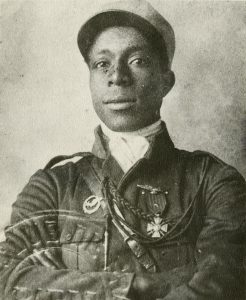
Eugene Bullard. Courtesy of National Museum of the U.S. Air Force
A year after Bullard arrived in Paris, in August 1914, France entered World War I. He joined the French Foreign Legion and participated in battles at the Somme, Artois Ridge, and Verdun, among others. The fighting was intense. At Artois Ridge, for example, his company suffered 80 percent casualties.
Bullard was awarded the Croix de Guerre for his bravery at the Battle of Verdun, which earned him the nickname “the Black Swallow of Death.” He also suffered a severe thigh injury. Recovering in Lyons, he was offered a position in the French Flying Corps because he was no longer fit to serve as an infantryman. He flew his first mission on September 8, 1917, as the first Black combat pilot, with the motto “Tout le Sang qui coule est rouge!” painted on his fuselage: “All blood runs red!” He flew 20 missions in all for the French, shooting down at least two enemy planes.
When the United States joined the war effort, Bullard applied to join the newly created U.S. Air Force. He should have been an attractive candidate — pilots were scarce, and Bullard had a proven track record, but his application never received a reply.
After the war ended, Bullard married a wealthy Frenchwoman and had two daughters, Jacqueline and Lolita. Though he divorced his wife in 1935, Bullard stayed in Paris with his daughters, working at the famous Paris nightclub Le Grand Duc, which he also partially owned. Later, he opened his own nightclub and an athletic club.
As World War II approached, Bullard agreed to join the French Resistance. He was a valuable asset to the cause. He spoke German, and his clubs were popular with German officers and Nazi sympathizers, who spoke freely under the false assumption that Bullard couldn’t understand them.
He was forced to leave Europe after the war began because he was injured by artillery fire in Orleans. Rather than allow him to be interrogated by the Gestapo, the French Resistance smuggled Bullard and his daughters to a Red Cross ship bound for the United States in 1940.
The former fighter pilot lived in New York City for the rest of his life, primarily working as an elevator operator at Rockefeller Center. He visited France again only once, briefly, when he was invited to relight the eternal flame at the Tomb of the Unknown Solider under the Arc de Triomphe. He was also made a chevalier (knight) of the French Legion of Honor, France’s highest national award, in 1959.
Bullard died in 1961. He was buried with full French military honors in the French section of a New York cemetery. He was not recognized by the United States for his bravery (nor did he receive an apology for his ignored application during World War I) until he was posthumously commissioned as a lieutenant in the U.S. Air Force in 1994.
What did Bullard’s childhood in Georgia have to do with his success in France? How much did the United States lose by denying Bullard and young men like Bullard the chance to fight? These questions are worthy of further examination, and the scale of Bullard’s story renders quick, summary answers to such questions either ridiculous or terribly daunting. Bullard is a fascinating and humbling figure, and his story is worth telling because it opens the way to a more informed discussion of still-unresolved American issues. It’s a reminder that great springs of potential are everywhere, waiting for a change in the environment.
This article appeared in an earlier form as part of “Jamil’s Georgia” on the SaportaReport.
READ MORE
FDR—the face of the New Deal in Georgia
[vc_row][vc_column][mk_fancy_title font_family=”none” el_class=”blog-titles”]FDR — the face of the New Deal in Georgia[/mk_fancy_title][/vc_column][/vc_row][vc_row][vc_column][vc_column_text]By Jamil ZainaldinWhen the Great Depression hit Georgia in the late 1920s, most of its population barely noticed, given that the state’s own economy still suffered from the ruin of the Civil War.
Sharecropping had become a way of life for many farmers, black and white. In addition to poverty and the plague of pellagra, there were also massive agricultural impediments due to large-scale land erosion, resulting from long-standing poor farming practices.
And then there was the other kind of plague, that of a cash-crop economy, cotton, making practically everyone dependent on the erratic swings of market prices and the weather, a situation that worsened when the boll weevil came.
Franklin Roosevelt understood all of this, because he lived on the land in rural Georgia and built a home in Warm Springs, the only one he would ever build for himself.
Depression and desperation brought on by polio led him to Warm Springs in 1924 to try the “healing waters” of a resort owned by his friend George Foster Peabody, of Columbus, Georgia. Only Roosevelt himself can know what exactly transpired in his mind, but the result of the water treatment was nothing less than a new lease on life.
Warm Springs, henceforth, became the home of his heart.
He loved traveling the backcountry roads in his specially equipped car and meeting farmers working the land. From this, he learned firsthand of Georgia’s problems, and he sought to understand their causes. He embarked on a self-education program, helped along by his friend and neighbor, Cason Callaway, who had experimented on his own land by employing modern agricultural practices of diversification and crop rotation.
When Roosevelt became president in 1933, Georgia remained an imprint in his mind of what ailed the nation—and what many in the nation needed: rural electrification, modern agricultural practices, education access, improved public health, and jobs.
The programs of the New Deal responded to the social crisis of the Great Depression. We know that only the Second World War would pull the nation out of its virtual economic collapse, but Roosevelt’s energy, his incantation that “the only thing we have to fear is fear itself,” restored the nation’s ailing spirit, put millions to work, propped up farmers, and set new standards for minimum wage and hours requirements.
Although many welcomed the financial investment in the South’s economy, some of Georgia’s politicians in the 1930s actively campaigned against the New Deal programs as contrary to “our way of life.” Factory and mill owners especially worried about the impact of wage-and-hour regulation.
And because his New Deal policies of support for labor unions and black workers and their families met intractable opposition from political leaders like Georgia governor Eugene Talmadge, Roosevelt moderated his position. As New Georgia Encyclopedia author Kaye Minchew points out, such resistance to parts of the New Deal was hardly unique to Georgia, as Jim Crow had long since lodged itself in the law and constitutions of all the southern states.
In hindsight, what is extraordinary about Roosevelt in Georgia is how much support of the general mass of the voting population he retained.
Roosevelt won Georgia by generous margins in all four of his presidential elections—even as these same voters supported politicians at odds with his policies. He traveled and spoke around the state, and set up his philanthropic polio foundation in Warm Springs. His funeral train’s procession gathered masses of supporters at every station it passed through in Georgia in 1945.
As president, it was Roosevelt who led an isolationist nation into preparation for war. It is hard to imagine any other politician of the time doing so. After Pearl Harbor, the nation’s path was set. It was his leadership of the Allied coalition that ensured the outcome of the war.
One might ask, what if Roosevelt had never ventured to Georgia in 1924? What would have happened to him? Would he have received the healing he so desperately needed? Would he have ever experienced firsthand the trials thrust upon hard-working, but poor, people by circumstances beyond their control?
If he had not learned about the sufferings of Georgians by listening to those he met on trips around the countryside, could he have truly grasped the extent of personal suffering the Great Depression was causing nationwide?
Would he have emerged from his polio strong enough and wise enough to take on the problems of this country and then to take it out of isolation into an all-consuming war that was necessary in hindsight?
Just as he emerged from the isolation of his illness and learned to engage with the world again, as Warm Springs had allowed him to do, Roosevelt as president helped lead the country out of its isolation into a worthy fight.
Without U.S. involvement in the war, what would have happened to the world?
When I visit Warm Springs today and gaze upon the preserved healing pool that brought Roosevelt here, it is with an awesome appreciation that I am also stepping into sacred civic space.
To Warm Springs I say, the free world forever is in your debt.
This article appeared in an earlier form as part of “Jamil’s Georgia” on the SaportaReport.
Jamil Zainaldin is the president of Georgia Humanities.
[/vc_column_text][/vc_column][/vc_row] READ MOREThe Georgia roots of one of the 20th century’s most successful songwriters
[vc_row][vc_column][mk_fancy_title size=”30″ font_family=”none” el_class=”blog-titles”]The Georgia roots of one of the 20th century’s most successful songwriters[/mk_fancy_title][/vc_column][/vc_row][vc_row][vc_column][vc_column_text]By Laura McCartyMusic- and film-making are thriving businesses in Georgia now, but Georgia native Johnny Mercer—writer of such memorable songs as “Glow-Worm” and “Jeepers Creepers,” which were wildly popular in their day—successfully blended both during his long career.
A recent book by New Georgia Encyclopedia author Glenn T. Eskew, Johnny Mercer: Southern Songwriter for the World (published by the University of Georgia Press), explores the life and global legacy of Mercer—one of the most prolific, successful, and popular songwriters of the 20th century.
Modern American popular music developed as artists and other performers blended and adapted the sounds of the roots music traditions of diverse cultural groups. Migration and tourism provided opportunities for people to meet and hear each other’s tunes, but the commercial music publishing business and sound recordings sped up these processes.
Right in the middle of it all was Savannah native Johnny Mercer, whose long career spanned the 1930s through the 1960s. Mercer wrote lyrics for more than 1,000 songs, and he performed and recorded with most of the major singers of the era. Broadway shows and Hollywood movies also featured his tunes, and Mercer cofounded Capitol Records in Los Angeles.
At the time of his birth in 1909, Mercer’s family was prosperous. His father was a lawyer and investor. The family worshipped at Christ Church, and Mercer received a fine classical education. He also attended minstrel shows and plays, bought records, and eventually listened to the radio. Despite the color line, Mercer was surrounded by African American music within the urban environment of Savannah.
After his father’s business failed in 1927, Mercer was unable to attend college and had to make a career for himself. He moved to New York and found work as a singer in traveling shows. His relocation made him part of what demographer James N. Gregory calls the Southern Diaspora. Between 1900 and 1970 an estimated 30 million white and black southerners left the region, in favor of the North and West. Mercer found many opportunities as a musician due to the influx of talents that gathered in New York.
The New York music scene of the late nineteenth and early twentieth century was known as Tin Pan Alley. Most of the luminaries of this era were immigrants, and many were Jewish. Nonetheless, one of the genres that they found success with was the “back to Dixie” song. With his southern accent and jazz singing style, Johnny Mercer brought new authenticity to that genre.
Mercer’s first published work came in 1929, “Out of Breath (and Scared to Death of You)” for the show The Garrick Gaieties. He also soon won a singing competition at the Hotel Biltmore, which opened doors for many other collaborations with white and African American artists. He wrote lyrics for such Big Band standards as Hoagy Carmichael’s “Lazy Bones,” and he also provided lyrics for many of the top singers of the day, including Billie Holliday.
As the movie industry developed in Hollywood, there were many opportunities for lyricists and musicians, and many of Mercer’s New York collaborators began to travel west to take advantage of them. During World War II, Hollywood incorporated several Mercer songs into patriotic propaganda films, such as The Fleet’s In (1942) and Star Spangled Rhythm (1942). While the films may not be remembered broadly, songs like “That Old Black Magic” and “Tangerine” became standards for singers. Mercer’s movie songs garnered nineteen nominations and four Academy Awards, and he is perhaps best remembered for “Moon River,” the theme song of the 1961 film Breakfast at Tiffany’s.
The next step in Mercer’s career came in 1942, when he cofounded Capitol Records in Los Angeles with Buddy DeSylva (whose wealth came through the movie business) and Glenn Wallichs (whose wealth came from owning record stores). Mercer worked as the “artists and repertoire” agent for the company, signing artists Peggy Lee and Nat King Cole, among others. He also incorporated innovative marketing strategies, including the design of Capitol’s signature Los Angeles headquarters, which resembles a stack of records.
In 1955 Mercer and his partners sold Capitol to EMI, and with the proceeds from that sale, he returned funds to Savannah to repay the debts that had wrecked his father’s fortune in 1927. He indicated that he made this move out of a sense of southern honor. Not too long afterward, Mercer bought a home on Burnside Island, near Savannah, where he and his family would come on vacation and where he eventually retired.
The 1960s saw the rise of rock ‘n’ roll, the next step in the trajectory of American music, which displaced the tunes of the Great American Songbook, with which Mercer is associated. In 1965, upon the invitation of a Savannah legislator, Mercer submitted a song to the Georgia General Assembly as consideration for a new state song, but it lost out to “Georgia On My Mind” by his old collaborator Hoagy Carmichael, which had been popularized by Albany-native Ray Charles on his 1960 album The Genius Hits the Road.
Johnny Mercer died in 1976. His widow donated his papers to Georgia State University, and friends and family created the Johnny Mercer Foundation, which supports music education. Georgia politicians renamed the river that ran in front of his home “Moon River,” and the city of Savannah christened its municipal theater the Johnny Mercer Theatre. Singers around the world continue to perform his songs and to adapt them for use in movies and television shows.
This article appeared in an earlier form as part of “Jamil’s Georgia” on the SaportaReport.
Laura McCarty is the executive vice president of Georgia Humanities.
[/vc_column_text][/vc_column][/vc_row] READ MOREWar and peace and in between: helping veterans heal
[vc_row][vc_column][mk_fancy_title font_family=”none” el_class=”blog-titles”]War and peace and in between: helping veterans heal[/mk_fancy_title][/vc_column][/vc_row][vc_row][vc_column][vc_column_text]By Georgia Humanities StaffConnections—between veterans themselves, between veterans and civilians, between literature and war, and between literature and healing—are key to Talking Service, a program that helps veterans transition from war zone to home front through reading and discussion. Using Standing Down: From Warrior to Civilian, an anthology produced for the program by the Great Books Foundation, Talking Service brings veterans together with a moderator to share their stories through the lens of literature. With a grant from the National Endowment for the Humanities, Georgia Humanities sponsored Talking Service discussions in four north Georgia communities in 2014–15.
Literature has helped veterans and civilians alike cope with the trauma of war since the age of Homer’s Iliad and Odyssey, two of the 40-plus excerpts from novels, poems, biographies, diaries, and newspaper articles that comprise Standing Down. Readings span more than 2,500 years, and were chosen to speak to veterans from all eras. The tale of the ancient warrior Odysseus, for example, remains urgent and awe-inspiring because it is universal. Readers crave— have always craved—words of war and war’s aftermath because, according to Talking Service moderator and University of North Georgia professor Kristin Kelly, “Literature can mitigate the pain of war.”
Sharing, too, can mitigate pain. Program facilitators were not necessarily surprised by the veterans’ response to the literature, but rather by the way they responded to each other. Facilitators expected to see a bond between veterans of recent conflicts, but were thrilled also to see a bond between younger veterans and those who had fought in earlier conflicts like Vietnam.
Civilian moderators Kristin Kelly and Randy Hendricks, a professor at the University of West Georgia, were powerfully moved by their experiences. “What truly impressed me about the program,” says Hendricks, “was how much I myself learned from [those] who participated, particularly ways that civilians and veterans might find grounds to talk.” Kelly’s experience taught her that civilians bear a responsibility to hear the stories of their soldiers: “Witness is powerful medicine. I encourage all citizens to participate in one of the most crucial conversations mankind must continue to have: the human costs of war.”
Now referred to as post-traumatic stress disorder, or PTSD, postwar trauma has always been the heavy price combat exacts on soldiers and the societies to which they return. Indeed, should it come as any surprise that the Iliad, a story of war, is followed by an entire second volume, the Odyssey, devoted to the difficulties of a warrior’s homecoming? Stories like that of Odysseus help veterans understand this transition, a process that can take years, or even a lifetime. World War II veteran Edward W. Wood Jr. explains, “People out there are still walking around wounded. . . . the route from combat to cure is a coherent story about yourself.”[/vc_column_text][/vc_column][/vc_row]
READ MORE